

Aide:Formules TeX

|
Cette page d'aide n'est pas finie
Veuillez considérer le plan et le contenu comme incomplets et en préparation, temporaires et sujets à caution. Si vous souhaitez participer, il vous est recommandé de consulter sa page de discussion au préalable.
|
Depuis janvier 2003, les formules mathématiques sur Wikinews peuvent être écrites avec le système TeX.
Cette syntaxe est beaucoup plus facile à écrire et à lire que l'HTML. Les formules sont présentées en HTML si possible, autrement une image PNG est produite par le serveur.
Les règles de base sont les suivantes :
- les formules se mettent entre <math> ... </math> ;
- les caractères + - = / ' | * < > ( ) peuvent être tapés directement ;
- à l'intérieur d'une formule, on peut délimiter des groupes à l'aide d'accolades {}, pour grouper une expression en indice, par exemple. Pour obtenir une accolade dans le rendu, il faut donc taper \{ ou \}.
Caractères spéciaux[modifier | modifier le wikicode]
| Fonctionnalité | Syntaxe | À quoi ça ressemble |
|---|---|---|
| Accents L'exemple ci-contre montre les différents accents sur la lettre o. |
\hat o \acute o \ddot o \vec o \check o \grave o \breve o \widehat {abc} \tilde o \bar o \dot o | |
| Opérateurs binaires | \star \times \circ \cdot \bullet \cap \cup \vee \wedge \oplus \otimes \triangle \vdots \ddots | |
| \pm \mp \triangleleft \triangleright | ||
| Opérateurs n-aires | \sum \prod \coprod \int \oint \bigcup \bigcap \bigsqcup \bigvee \bigwedge \bigoplus \bigotimes \bigodot \biguplus | |
| Ellipses | x + \cdots + y ou x + \ldots + y | ou |
| Séparateurs | ( ) [ ] \{ \} \lfloor \rfloor \lceil \rceil \langle \rangle / \backslash | \| \uparrow \Uparrow \downarrow \Downarrow \updownarrow \Updownarrow | |
| Fonctions std. (bien) | \sin x + \ln y +\operatorname{sgn} z | |
| Fonctions std. (mal) | sin x + ln y + sgn z | |
| Fonctions trigonométriques | \sin \cos \tan \operatorname{cotan} \sec \operatorname{cosec} | |
| Fonctions trigonométriques inverses | \operatorname{Arcsin} \operatorname{Arccos} \operatorname{Arctan} | |
| Fonctions trigonométriques hyperboliques | \operatorname{sh} \operatorname{ch} \operatorname{th} \operatorname{coth} | |
| Fonctions d'analyse | \lim \sup \inf \limsup \liminf \log \ln \lg \exp | |
| Fonctions d'algèbre linéaire | \det \deg \dim \hom \ker | |
| Arithmétique modulaire | s_k \equiv 0 \pmod{m} | |
| Dérivées | \nabla \partial x \ dx \dot x \ddot y | |
| Ensembles | \forall \exists \empty \varnothing \cap \cup | |
| Logique | p\wedge \land \bar{q} \to p\lor \lnot q \rightarrow p\vee | |
| Racines | \sqrt{2}\approx\pm 1,4 | |
| \sqrt[n]{x} | ||
| Relations | \sim \simeq \cong \le \ge \equiv \not\equiv \approx = \propto | |
| Relations négativées | \not\sim \not\simeq \not\cong \not\le \not\ge \not\equiv \not\approx \ne \not\propto | |
| Relations d'ensembles | \subset \subseteq \supset \supseteq \in \ni | |
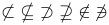
| Relations négativées | \not\subset \not\subseteq \not\supset \not\supseteq \not\in \not\ni | |
| Géometrie | \triangle \angle 45^\circ | |
| Flèches | \leftarrow \rightarrow \leftrightarrow \longleftarrow \longrightarrow |
|
| \Leftarrow \Rightarrow \Leftrightarrow \Longleftarrow \Longrightarrow \Longleftrightarrow |
| |
| Symboles divers | \hbar \wr \dagger \ddagger \infty \vdash \top \bot \models \vdots \ddots \imath \ell \Re \Im \wp \mho |
|






![{\displaystyle (\;)\;[\;]\;\{\;\}\;\lfloor \;\rfloor \;\lceil \;\rceil \;\langle \;\rangle \;/\;\backslash \;|\;\|\;\uparrow \;\Uparrow \;\downarrow \;\Downarrow \;\updownarrow \Updownarrow }](https://wikimedia.org/api/rest_v1/media/math/render/svg/04fb7dc34c87be59307d0d56e4fb72bc0541f405)












![{\displaystyle {\sqrt[{n}]{x}}}](https://wikimedia.org/api/rest_v1/media/math/render/svg/7b3ba2638d05cd9ed8dafae7e34986399e48ea99)










Indices, exposants[modifier | modifier le wikicode]
| Fonctionnalité | Syntaxe | À quoi ça ressemble | |
|---|---|---|---|
| en HTML | en PNG | ||
| Exposant | a^2 | ||
| Indice | a_2 | ||
| Regroupement | a^{2+2} | ||
| a_{i,j} | |||
| Combiner indice et exposant | x_2^3 | ||
| Indice et exposant précédents | {}_1^2\!X_3^4 | ||
| Dérivée (bon) | x' | ||
| Dérivée (mauvais en HTML) | x^\prime | ||
| Dérivée (mauvais en PNG) | x\prime | ||
| Dérivées temporelles | \dot{x}, \ddot{x} | ||
| Soulignés et surlignés | \hat a \bar b \vec c \overline {g h i} \underline {j k l} | ||
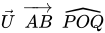
| Vecteurs et angles | \vec U \overrightarrow{AB} \widehat {POQ} | ||
| Somme | \sum_{k=1}^N k^2 | ||
| Produit | \prod_{i=1}^N x_i | ||
| Limite | \lim_{n \to \infty}x_n | ||
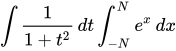
| Intégrale indéfinie ou définie | \int \frac{1}{1+t^2}\, dt \int_{-N}^{N} e^x\, dx | ||
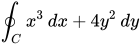
| Intégrale curviligne | \oint_{C} x^3\, dx + 4y^2\, dy | ||
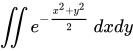
| Intégrale double | \iint e^{-\frac{x^2+y^2}{2}\, dx dy | ||
| Intersections | \bigcap_1^{n} p | ||
| Réunions | \bigcup_1^{k} p | ||






Fractions, matrices, plusieurs lignes[modifier | modifier le wikicode]
| Fractions | \frac{2}{4} ou {2 \over 4} | ou |
| Coefficients binomiaux, combinaisons | {n \choose k} ou C_n^k | ou |
| Matrices | \begin{pmatrix} x & y \\ z & v \end{pmatrix} | |
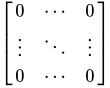
| \begin{bmatrix} 0 & \cdots & 0 \\ \vdots & \ddots & \vdots \\ 0 & \cdots & 0\end{bmatrix} | ||
| \begin{Bmatrix} x & y \\ z & v \end{Bmatrix} | ||
| \begin{vmatrix} x & y \\ z & v \end{vmatrix} | ||
| \begin{Vmatrix} x & y \\ z & v \end{Vmatrix} | ||
| \begin{matrix} x & y \\ z & v \end{matrix} | ||
| Distinctions de cas | f(n)=\left\{\begin{matrix} n/2, & \mbox{si }n\mbox{ est pair} \\ 3n+1, & \mbox{si }n\mbox{ est impair} \end{matrix}\right. | |
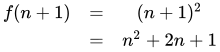
| Équations sur plusieurs lignes | \begin{matrix}f(n+1)&=& (n+1)^2 \\ \ & =& n^2 + 2n + 1\end{matrix} |





Jeux de caractères[modifier | modifier le wikicode]
| Lettres grecques minuscules (sans omicron !) | \alpha \beta \gamma \delta \epsilon \varepsilon \zeta \eta \theta \iota \kappa \lambda \mu \nu \xi o \pi \varpi \rho \sigma \varsigma \tau \upsilon \phi \varphi \chi \psi \omega | <br\>
|
| Lettres grecques majuscules (sans Omicron !) | \Alpha \Beta \Gamma \Delta \Epsilon \Zeta \Eta \Theta \Iota \Kappa \Lambda \Mu \Nu \Xi O \Pi \Rho \Sigma \Tau \Upsilon \Phi \Chi \Psi \Omega | <br\>
|
| Ensembles usuels | x\in\mathbb{R}\sub\mathbb{C} | |
| gras (pour les vecteurs) | \mathbf{x}\cdot\mathbf{y} = 0 | |
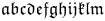
| Fraktur | \mathfrak{a b c d e f g h i j k l m} \mathfrak{n o p q r s t u v w x y z} |
|
| Gras | \mathbf{ABCDEFGHIJKLM} \mathbf{NOPQRSTUVWXYZ} |
|
| Roman | \mathrm{ABCDEFGHIJKLM} \mathrm{NOPQRSTUVWXYZ} |
|
| normal | ABCDEFGHIJKLM NOPQRSTUVWXYZ |
|
| Script | \mathcal{ABCDEFGHIJKLM} \mathcal{NOPQRSTUVWXYZ} |
|
| Hébreu | \aleph \beth \daleth \gimel |


















Délimiteurs dans les grandes équations[modifier | modifier le wikicode]
| Mauvais | ( \frac{1}{2} ) | |
| Mieux | \left ( \frac{1}{2} \right ) |


\left et \right peuvent être utilisés avec divers délimiteurs :
| Parenthèses | \left( A \right) | |
| Crochets | \left[ A \right] | |
| Accolades | \left\{ A \right\} | |
| Chevrons | \left\langle A \right\rangle | |
| Barres (de valeur absolue, par exemple) | \left| A \right| | |
| Utilisez \left. et \right. pour ne faire apparaître qu'un seul des délimiteurs | \left. {A \over B} \right\} \to X |

![{\displaystyle \left[A\right]}](https://wikimedia.org/api/rest_v1/media/math/render/svg/408e5e41e60df49212d5206ede3da5fb0de7b83f)


Espacement[modifier | modifier le wikicode]
TeX gère automatiquement la plupart des problèmes d'espacement, mais vous pouvez souhaiter contrôler l'espacement manuellement dans certains cas.
| double cadratin | a \qquad b | |
| cadratin | a \quad b | |
| grand espace | a\ b | |
| espace moyenne | a\;b | |
| espace fine | a\,b | |
| pas d'espacement | ab | |
| espacement négatif | a\!b |


Astuce[modifier | modifier le wikicode]
Pour forcer une formule à la pleine taille, il suffit d'ajouter une espace fine en fin de formule : \, (contre-oblique virgule )
<math>a(1+e^2/2)</math> donne

<math>a(1+e^2/2)\,</math> donne

Voir aussi[modifier | modifier le wikicode]
Lien interne[modifier | modifier le wikicode]
Liens externes[modifier | modifier le wikicode]
- Modèle:En icon Document d'introduction à Tex, sous format PDF. Lire à partir de la page 39 pour une bonne introduction à l'écriture de formules mathématiques.
- Modèle:Fr icon Document d'introduction à Tex, lire les pages 32 à 41.
- Modèle:En icon AMS Latex, les extensions et conventions de la société américaine de mathématiques.